
How does 捷捷寶寶粥 handle parents’ detailed questions with limited customer service resources? Jessie, Assistant Marketing Manager, shares how the team implemented Raccoon AI customer service to handle FAQs, campaign Q&A, and response optimization—reducing the pressure on support to stay constantly online.
Customer Stories

What is AI guided selling? Learn the differences between an AI shopping assistant and a traditional customer service chatbot, its 5 key benefits, e-commerce use cases, and implementation steps. See how on-site guided selling can work with off-site GEO, from AI search visibility to product recommendations, to improve the customer shopping experience.
Insights

Traffic monetization is the process of turning visitors from your website, search, social channels, or ads into actual revenue through product sales, service bookings, and customer engagement. For brands, the priority is not only attracting more visitors, but helping high-intent shoppers find the right products, resolve concerns, and complete their purchase. Even with ongoing investment in advertising and marketing, traffic does not automatically become orders. Mismatched ad promises and product pages, unanswered questions, and overly complex checkout flows can all cause customers to leave. Brands can improve traffic monetization across five stages: precise acquisition, real-time engagement, customer retention, conversational conversion, and repeat purchase management—gradually increasing the value of every interaction. These five stages serve as an operational diagnostic framework. Customers may not move through them in order, and some may purchase on their first visit. What is traffic monetization? Why do brands have traffic but no orders? Definition and core concept of traffic monetization Traffic represents opportunities for customers to engage with a brand; monetization means turning those opportunities into revenue. Content websites may monetize through ad placements or subscriptions, while e-commerce brands typically generate revenue through product orders, service transactions, and repeat purchases. This article focuses on brand sales and how to connect visitor intent to the purchase journey. Effective traffic monetization for brands requires balancing demand fit, buying experience, and operating cost. A large volume of low-intent visitors may increase page views without driving qualified orders. Sales generated through steep discounts may also be offset by ad spend, shipping, and return costs. When measuring results, brands should evaluate both revenue and profit....
Insights

Private domain traffic refers to the customer base a brand can continuously engage and serve through channels such as a membership system, Email, and LINE Official Account after obtaining customer consent. The goal of private domain management is to turn a single visit or purchase into a sustainable customer relationship, gradually building repeat purchases and long-term value across four stages: traffic acquisition, retention, engagement, and conversion. As advertising costs rise and the same budget brings in fewer new customers, brands need to ask: after paid traffic leaves the website, can we contact those customers again? Yes—but only if they have voluntarily provided contact information or subscribed to brand messages. A single website visit does not mean the brand has established a directly reachable relationship. Changes to third-party Cookie and browser tracking restrictions also make it more important for brands to focus on customer-provided data and direct interactions. This article starts with the differences between public and private domains, then outlines operating methods, tools, metrics, and use cases to help brands build an actionable private domain strategy. What Is Private Domain Traffic, and Why Should Brands Invest in It? Definition and Core Concepts of Private Domain Traffic Private domain traffic is not the name of a specific platform. It is a way to manage customer relationships. When customers are willing to become members, subscribe to newsletters, or join a LINE Official Account, brands can provide service, content, and product information at the right moments without starting from a cold audience every time. However, "private domain" does not mean the brand owns the customer, nor does it mean messages can be sent for free or without limits. Third-party platforms such as LINE...
Insights

Introduction As consumers begin asking ChatGPT and Gemini directly which brands they recommend, whether a brand appears in AI-generated answers has become a critical marketing question. On October 21, WorkDuo invited GEO consultant Frank Chiu to host an online GEO (Generative Engine Optimization) masterclass for users. Rather than focusing on concepts, the session covered how to interpret monitoring data and how to get brands mentioned by AI. Below are the key takeaways. Why GEO Matters Now AI is becoming a new entry point for consumer decision-making. In the session, Frank noted that international consulting firms have also started advising clients to prioritize GEO. In the past, brands only needed to manage their Google rankings. Today, users may never click a link and may simply trust the answer AI provides. If a brand does not appear in that answer, it is effectively not on the consumer’s consideration list. Understanding AI visibility: The four quadrants of mentions and citations Frank summarized the core GEO metrics into three areas: mentions, where the brand name appears in AI answers; citations, where AI includes a link to your website; and traditional SEO rankings. Mentions and citations create different value. Mentions build brand awareness and trust but do not directly drive traffic. Citations can generate traffic and support remarketing. Crossing the two...
Insights

To implement AI effectively, enterprises should first define the business problem they want to improve, assess available data and resources, then choose the right tools and implementation model. Validate impact through a small-scale pilot, then roll out gradually and optimize continuously. The core objective of AI implementation is to embed artificial intelligence into real workflows and deliver measurable gains in efficiency, quality, or revenue. Preparation: Clarify business challenges, assess data and systems, and confirm budget, owners, and success metrics. Strategy: Select priority use cases, compare in-house development, SaaS, and outsourcing, and plan pilot scope and data security. Execution: Test real tasks, train employees, define human-AI collaboration, and scale based on results. What is AI implementation, and why should enterprises adopt AI? Definition of AI implementation: integrating AI into existing processes and systems AI implementation means integrating artificial intelligence technologies into existing workflows or systems to support information understanding, content generation, data analysis, prediction, or task execution. Examples include enabling AI to answer customer questions based on an enterprise knowledge base, summarize meeting notes, or help sales teams consolidate customer needs. Implementation does not necessarily require building your own model or replacing existing systems. Enterprises can purchase ready-to-use tools or connect existing CRM, customer service platforms, and internal data through APIs to create workflows that fit their needs. The relationship between AI implementation and AI transformation AI implementation usually starts with a specific task or department; AI...
Insights

AI transformation is the process of integrating artificial intelligence into daily workflows, employee responsibilities, and operational decision-making to continuously improve efficiency, service quality, and business outcomes. For enterprises, AI transformation is not just about purchasing tools; it also requires data management, human-AI collaboration, and performance tracking mechanisms. Companies can start with small-scale applications in a single department, validate results, and then expand gradually. Key takeaways: AI transformation spans processes, people, and business models, with a focus on sustainable operational change. AI transformation and digital transformation are closely connected; AI transformation focuses more specifically on applying AI to analysis, judgment, generation, and execution. The 5 key benefits of AI transformation include efficiency, decision-making, customer experience, cost management, and long-term competitiveness, but outcomes must be measured. Enterprises should define business goals first, then prepare data, assign responsibilities, select partners, and run pilots. SMBs do not need to start by building their own models; they can first evaluate practical needs such as customer service, document organization, or internal knowledge search. What is AI transformation? A clear definition AI transformation definition: redesigning how work gets done around business goals Enterprise AI transformation starts with business goals. It uses artificial intelligence to redesign how work is processed while establishing mechanisms for data management, team collaboration, and performance tracking. AI can help understand text, summarize information, predict trends, or execute authorized tasks, but businesses still need to decide which tasks are suitable for automation and which decisions should remain with people....
Insights

What types of questions can AI customer service handle? How much content do you need to prepare? Can it integrate with existing systems? After launch, do you still need human agents? As product inquiries, order questions, and messages across channels continue to grow, companies may start considering AI to share the customer service workload. But from evaluation to launch, beyond features and pricing, it is also important to understand data preparation, system integrations, human handoff, and ongoing maintenance. This article covers 9 common questions companies ask before implementation, including needs assessment, setup, response quality, and costs, plus a simple four-step rollout process. You can read based on your current needs or use these questions in vendor discussions to confirm whether a solution fits your customer service workflow. Before implementing AI customer service, confirm these five things What should you address first? Start with common needs such as product questions, delivery, and appointments, then prioritize the scenarios to improve first. Can your existing content be used? Review FAQs, product information, and service policies, and update any outdated or inconsistent content. Which systems need to be connected? List your main customer service channels and any order, member, or CRM lookup requirements. When should conversations be handed off to a human? Confirm the handoff process for insufficient information, special requests, complaints, or customers asking for a human agent. How do you determine whether implementation is effective? First record current ticket volume, handling time, and service quality, then track changes after launch and evaluate total cost together. Pre-implementation assessment for AI customer service Q1: Do you need to replace your existing customer service system to implement AI customer service?...
Insights
Product questions, delivery updates, and campaign rules come up every day, but customer service teams do not always have enough time to answer each one manually. When companies start evaluating AI customer service, the first question is usually: “How much budget do we need? Beyond the subscription fee, what other costs should we plan for?” AI customer service costs typically include plan and usage fees, initial implementation, system integrations, and ongoing maintenance. Depending on the scope, first-year external spending can range from around NT$12,000 to more than NT$2.8 million. If you want AI to help check orders, recommend products, or retrieve member information, the required features and data will increase, and the budget should be adjusted accordingly. This article explains what AI customer service costs include, summarizes common pricing models, key cost drivers, enterprise budgeting considerations, and often-overlooked costs, and introduces a simple way to evaluate ROI so teams can compare solutions and plan implementation budgets. What does AI customer service cost include? When evaluating AI customer service costs, start with three categories: pre-launch setup costs, plan and usage fees during operation, and the team’s ongoing maintenance effort. Below are five common cost items. Whether they are charged separately depends on what each plan includes. 1. Platform licensing and customer service system fees Platform fees may cover AI responses, a knowledge base, conversation management, and some analytics features, or they may only include the AI module. If the solution needs to work with an existing CRM, ticketing, or customer service system, the original system license may still need to be paid. Additional seats, brand accounts, and advanced modules may also be billed separately...
Insights
Customer message volume continues to grow, while customer service teams are often constrained by headcount, response speed, and multi-platform management. When questions come in simultaneously from the website, LINE, Messenger, Instagram DM, and Email, relying on human agents alone makes it difficult to maintain real-time responses. It can also cause customers who originally had purchase or booking intent to drop off while waiting. As a result, AI customer service has evolved from a simple FAQ auto-reply tool into a critical application for managing large volumes of customer conversations, improving service efficiency, and optimizing customer service workflows. A mature AI customer service system is not just about “automatic replies.” It can understand customer intent, read company knowledge, guide the next step based on service workflows, and even connect with business systems to complete inquiries, lead capture, bookings, and task assignment—while smoothly handing off to human agents when human judgment is required. This article starts with what AI customer service is, explains how it works, compares it with traditional customer service and legacy chatbots, and summarizes its pros and cons, selection criteria, common use cases, implementation process, and performance metrics to help businesses determine whether AI customer service is the right fit. What Is AI Customer Service? AI customer service is a system that applies artificial intelligence to customer service workflows. Through natural language understanding, a company knowledge base, conversation flows, and system integrations, it helps businesses handle customer questions, product inquiries, order lookups, booking guidance, data collection, customer service routing, and after-sales support....
Insights

What is an AI Agent? Understand the definition, how it works, how it differs from traditional AI and chatbots, common types, enterprise use cases such as customer service, and 4 questions to ask before adoption.
Insights
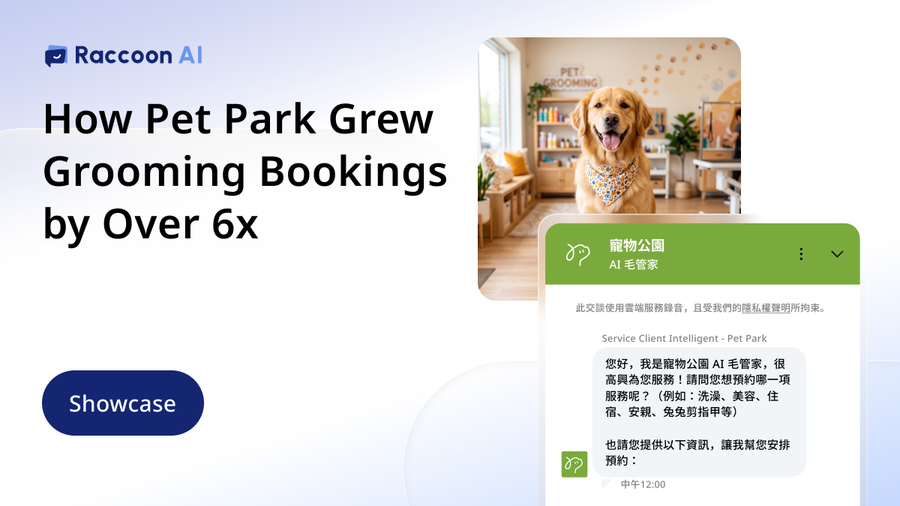
Pet Park, one of Taiwan’s leading pet retail and ecommerce chains, adopted Raccoon AI Service to transform a complex grooming booking workflow. With intelligent scripts and seamless integration into the existing customer service environment, AI now proactively collects booking details and replies instantly, helping grooming consultation conversion rise from 35.71% to 64.2%, with completed bookings up 625% and revenue up 495%.
Customer Stories