Raccoon AI GEO(WorkDuo) × Frank Chiu GEO Masterclass: Three Things Brands Need to Understand, from AI Monitoring to Optimization
Introduction
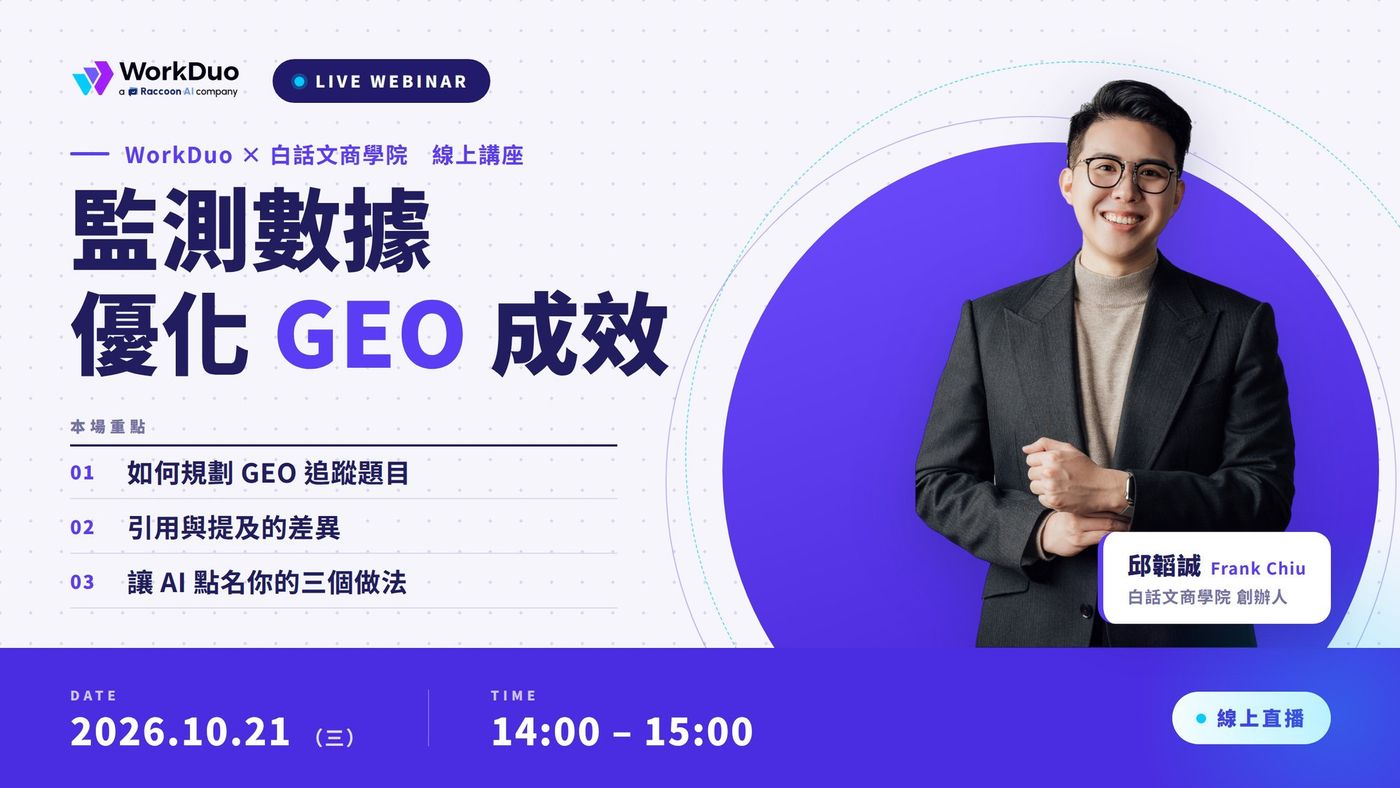
As consumers begin asking ChatGPT and Gemini directly “which brand is more recommended,” whether a brand appears in AI-generated answers has become a critical marketing question. On October 21, WorkDuo invited GEO consultant Frank Chiu to host an online GEO(Generative Engine Optimization) masterclass for users. Rather than focusing on concepts, the session covered how to interpret monitoring data and how to get brands mentioned by AI. Below are the key takeaways.
Why GEO Matters Now
AI is becoming a new entry point for consumer decision-making. In the session, Frank noted that international consulting firms have also started advising clients to prioritize GEO.
In the past, brands only needed to manage their Google rankings. Today, users may never click a link and may simply trust the answer AI provides. If a brand does not appear in that answer, it is effectively not on the consumer’s consideration list.
Understanding AI visibility: The Four Quadrants of Mentions and Citations
Frank summarized the core GEO metrics into three areas:Mentions(the brand name appears in AI answers),Citations(AI includes a link to your website), and traditional SEO rankings.
Mentions and citations create different value. Mentions build brand awareness and trust but do not directly drive traffic. Citations can generate traffic and support remarketing. Crossing the two creates a four-quadrant framework:

The Four Quadrants of Mentions × Citations
Word-of-mouth exposure in the upper-right quadrant is the easiest to overlook: consumers remember the brand, but this exposure is completely invisible in traffic reports.
Key Takeaway: Brand and Non-Brand Queries Must Be Evaluated Separately
One of the most counterintuitive points in the session was:A high mention rate does not mean the brand is performing well in AI.
Ask AI “How much does WorkDuo cost?” and the answer will naturally mention WorkDuo. If these brand queries are calculated together with general questions, mention rates and citation rates will be inflated. The report may look good, but it will not show the brand’s true market position.
Frank recommends dividing monitored queries into three categories and evaluating different metrics for each:
Query Type | Example | What to Evaluate | How to Act |
|---|---|---|---|
Brand Queries | “WorkDuo pricing” | Sentiment and accuracy: Is AI saying the right things, and is the tone positive? | Build a “brand facts database” to correct inaccurate AI information |
Non-Brand・Citation-Oriented | “What is GEO?” | Citations: Is AI citing your website? | Create knowledge-based content that AI can extract |
Non-Brand・Mention-Oriented | “Recommended noise-canceling headphones under NT$3,000” | Mentions: Are you included in AI’s recommendation list? | The highest-value category, directly shaping new customer awareness |
Among these, “non-brand・mention-oriented” queries are the most valuable to invest in: consumers have not chosen a brand yet, and AI’s recommendations become their first shortlist.
The Questions You Monitor Determine Whether the Report Is Credible
If you choose the wrong questions, more data will not make the report more useful. Frank recommends sourcing questions from three places: real customer service and LINE@ inquiries, keyword search volume, and “People Also Ask” in Google search results.
The workflow has 5 steps:
- Start broad, then narrow down: Run 50 questions for 7 days to collect initial data
- Review raw data: Identify which competitors AI actually mentions and cites
- Refine competitor settings: Update the true competitors back into WorkDuo
- Align on the final scope: Confirm at least 20 final questions with the team or client so the data is trusted
- Keep it stable for at least one quarter: Avoid changing the question list frequently so trends can be identified
Two Optimization Paths: Getting Cited and Getting Mentioned
To get cited by AI: Make your website crawlable, understandable, and trustworthy
AI cites websites by retrieving web content in real time to compose answers (RAG). Frank summarized three checkpoints:
- Crawlable:Ensure your website does not block AI crawlers (WorkDuo includes a built-in crawler detection tool)
- Understandable:Structure content clearly, use explicit headings, and include target keywords
- Trustworthy:Build E-E-A-T with data, sources, author information, and regular updates
Frank also recommends a free tool: Bing’s AI Performance report. It shows the grounding queries AI actually breaks out when composing answers, which can be used directly as content topics.
Getting mentioned by AI is harder than getting cited
If competitors are mentioned but you are not, start by identifying why: does your product not fit the need, or is brand awareness too low? There are three optimization priorities:
- Position the brand:Connect the brand to a specific problem, such as “affordable guitars for beginners”
- Be recognized:Monitor the full brand name, abbreviations, and product names
- Be included:Create comparison-based content and publish product specifications on your website in crawlable text
Negative mentions are still mentions. This is exactly why brand terms should be analyzed for sentiment.
Advanced: Give raw data to your own AI for analysis
At the end of the course, WorkDuo demonstrated how to use MCP (Model Context Protocol): connect monitored raw data directly to AI tools such as Claude and ChatGPT, then apply the three-dimensional framework above for analysis.
This step is especially useful for judgment-based work, such as determining whether sentiment is accurate or whether competitor names are missing. After analysis, newly discovered competitor domains can be added back into WorkDuo settings, making monitoring more accurate over time.
What participants said

What participants found most valuable
- Monitor branded and non-branded terms separately:Multiple participants mentioned this, and one agency participant said it could be applied directly to client projects
- Question framework and topic selection techniques:One participant described the topic framework as “excellent” and said it could directly help clients clarify brand goals
- Start with 50 questions, run them for 7 days, then refine:Multiple participants listed this as something they could do immediately after the course
- Identify real competitors through mentions and citations:Use data to redefine who your competitors are
- Give raw data to AI for analysis:Participants who had already been organizing raw data said the session gave them a more advanced next step
Next session
Based on user feedback, WorkDuo will host training sessions quarterly or semiannually. If you want to join the next session or first run an AI visibility check for your own brand, you are welcome to Start free trial.
Extended use case: Identify monitoring questions from customer service conversations
The course noted that strong GEO monitoring questions come from real customer questions.Raccoon AI AI customer serviceThe system can consolidate valuable pre-sales questions as a source of GEO monitoring questions.
Thank you to Frank Chiu for the sharing.