2026 AI Search Trends: How the Market Is Changing and How to Respond
Key Takeaways
- AI search in 2026 is answer-first. Visibility now depends on whether your brand is mentioned, cited, and represented in AI-generated answers—not just where you rank in search results.
- The major trends in AI-driven search optimization are measurable. Beyond traditional demand signals, teams must also monitor AI mentions, citations, sentiment, and competitor visibility.
- Responding to AI search requires rapid iteration.Optimizing existing pages, closing gaps in evaluation-stage content, and continuously tracking AI answers are now essential to maintaining visibility.
AI search trends are changing, and many teams only notice when it is already too late. Rankings may still look strong and traffic reports may appear stable, but AI answers may have already replaced your presence at critical moments.
When AI-generated summaries appear, users click traditional search results far less often. Pew Research found that when AI summaries are shown, these click-through rates drop from15% to 8%。
These AI-driven search optimization trends are changing who gets seen, trusted, and chosen.
In this guide, we explain the latest AI search technology trends, what to track, and how to respond before answer-level visibility disappears.
What Is AI Search?
AI search provides answers generated by AI models instead of returning a ranked list of links.
When a user enters a query, generative engines such as Google AI Overviews, ChatGPT, and Perplexity produce synthesized answers with cited sources. Understanding the difference between traditionalSEO (Search Engine Optimization) and GEO (Generative Engine Optimization), is now essential to maintaining traffic.
Users can refine the answer with follow-up questions. The goal of this experience is to resolve user intent quickly within the AI search interface.
Here is a simple comparison of traditional search and AI search:
What users see | Traditional Search | AI Search |
|---|---|---|
Result format | Ranked list of links | Generative answer summary |
Interaction model | Scroll and click links | Instant answer + follow-up prompts |
Visibility signals | Ranking position | Mentions or citations in the answer |
Content depth | Users choose which pages to view | The system synthesizes content from multiple sources |
Decision path | Click, read, compare | Review summary, refine the question |
In this context, visibility is no longer determined only by ranking position. It depends on whether your brand, page, or product is included, mentioned, or cited in AI answers. Even if a piece of content appears in traditional search results, users may still overlook it if it does not appear in the AI answer.
How AI Search Differs from Traditional Search
AI search trends are reshaping the user journey by replacing result lists with direct answers, followed by suggested follow-up queries.
Users typically do not need to click multiple links to compare information. They first review the AI-generated answer, then refine the query within the same interface. This materially changes click behavior and decision-making. According to Ahrefs, AI Overviews (AIO) can reduce click-through rates34.5%。
McKinsey’s analysis also shows thattraffic for unprepared brands could decline by 20% to 50%The remaining clicks from traditional search often come from consumers who are further down the funnel and more informed, because much of the decision-making process has already shifted to AI platforms before the click happens.
This changes content in the following ways:
- Pages must answer queries early and clearly
- Supporting content such as comparison articles, FAQs, and explainer pages influences outcomes earlier
- Visibility depends on being included in AI answers, not just ranking higher
Common Performance Tracking Mistakes
Many brands make the mistake of tracking performance only through traffic or rankings. Teams should insteadtrack brand mentions in AI search, so they can understand how often they are actually being recommended. Traditional search reports may indicate “strong performance,” while actual AI search visibility remains low.
Here is a simple way to classify queries and their corresponding content:
Query type | What the user wants to do | Best-fit content type |
|---|---|---|
Exploratory | Understand a topic or review available options | Overview, help articles, guides, glossary pages |
Evaluation | Compare options and narrow the shortlist | Comparison pages, reviews, pros and cons analyses, alternatives |
Decision | Take action or confirm the final choice | Pricing pages, use cases, demos, implementation FAQs |
Key AI Search Trends for 2026
Key trends in AI-driven search optimization, showing how discovery, visibility, and decision-making are defined within AI-generated answers.
These are the key AI search analytics trends you can observe directly and turn into measurable actions:
1. Discovery behavior is shifting from result lists to AI-generated answers
AI search now presents a synthesized answer before users interact with traditional results. In Google AI Overviews, users see summarized answers and selected sources before organic ranking results.
This changes how discovery works. Visibility is now earned at the answer level, not only after a click.
Next steps:
- Set a fixed set of priority queries to track, ranging from 20 to 50, or customize it based on your needs.
- Review them weekly and record whether AI-generated answers appear.
- Check whether the answer mentions your brand or page.
- Calculate the percentage of monitored priority queries where your brand is mentioned or cited in AI-generated answers.
- Calculate this metric and track it over time.
Formula:Included queries / total tracked queries
2. AI-generated answers reduce click-based discovery behavior
AI-generated answers change how users interact with search results. When the answer appears directly on the results page, users are less likely to click through to traditional search results.
Behavioral data confirms this shift.
A study by Pew Researchfound that when an AI-generated summary is shown, users click a traditional search link in only 8% of visits. When Google Search results show an AI summary, users are less likely to click links.
Next steps:
- Identify priority queries where AI answers appear, and compare click-through rates before and after those answers appear
- Measure the signal based on click-through rate changes between queries with and without AI answers, and continue tracking this change in GSC
3. Visibility depends on mentions and citations, not ranking position
Ranking high in the SERP does not guarantee visibility in AI search.
A study by Semrushfound that more than half of desktop AI Overviews and 60% of mobile AI Overviews did not cite the top-ranking organic search result. Surprisingly, in 25% of desktop sessions and 38% of mobile sessions, Google AI Overviews did not link to any of the top three pages at all.
This means traditional rankings do not directly translate into AI mentions and citations. You can use dedicated AI Overviews monitoring tools to see which of your pages are actually cited. Generative engines select sources based on content extractability and relevance, not just ranking position. This changes how visibility is evaluated.
Next steps:
- Review your highest-priority queries and confirm whether your page is still mentioned in AI answers, even when it already ranks in the top three
- Identify gaps where competitors are cited and you are not
- Use these gaps to prioritize rewriting or restructuring pages so they better match the content types and formats cited in AI answers
4. Follow-up prompts reshape user intent during the search process
AI search sessions evolve through follow-up prompts, changing intent within the same interaction. Users do not need to restate the query from scratch; they add context in place.
Here is an excerpt from Perplexity that asks follow-up questions to help users further refine intent within the same flow.
As intent becomes more focused, the system displays different sources and page types aligned with the refined user intent.
Next steps:
- Record the follow-up prompts that appear for priority queries
- Classify them by modifier type, such as role, industry, or use case
- Calculate the percentage of refined follow-up queries where your pages are cited and successfully capture the focused intent
5. AI answers favor product and deep contextual content at the decision stage
AI-generated answers show a clear preference for product-related pages, especially when users are evaluating solutions.
An x-Funnel analysis found that46% to 70% of all cited sources are product-related pages.Among them, 56% were cited at the TOFU stage, 46% at the MOFU stage, and 70.46% at the BOFU stage.
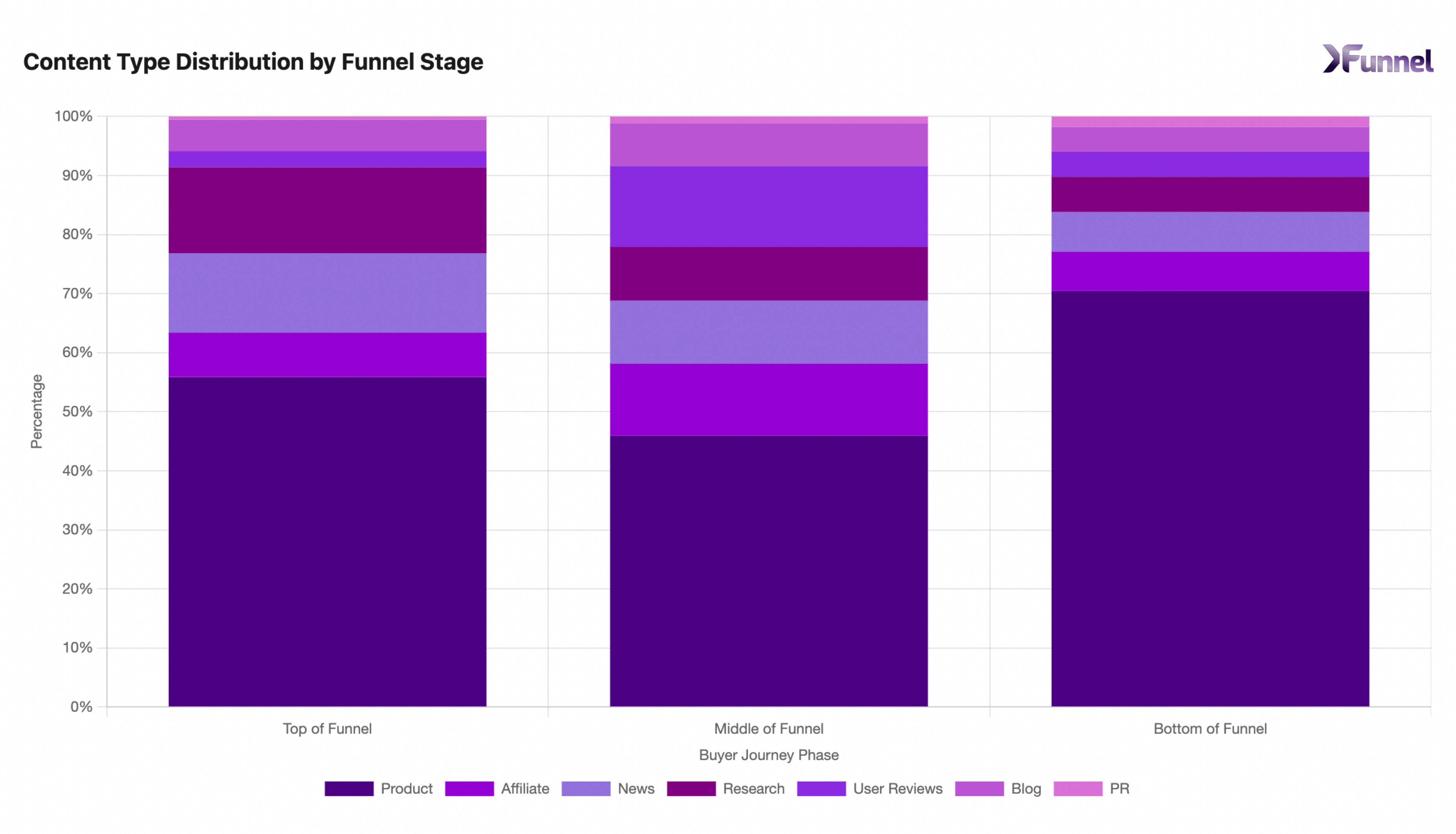
In addition, detailed content such as vendor comparisons, listicles, curated recommendations, and head-to-head comparisons dominates AI citations. This means factually rigorous, authoritative content is critical for AI-generated citations.
Next steps:
- Identify whether your product pages or solutions are cited in AI answers for decision-stage queries
- Compare this with the total number of decision-stage citations
- Expand and enrich content where gaps exist
6. AI Search Encourages Exploration Through Rich, Structured Results
Beyond text-based answers, AI search experiences use structured and visual cues to guide users through results, organizing information into steps, lists, categories, and visually enhanced sections that make options easier to scan and compare.
Below is an example excerpt of this presentation style in AI Overviews (AIO).
Users do not need to read lengthy explanations. Instead, they can review clearly segmented content elements and quickly understand the key points and next actions.
As a result, clearly structured and easy-to-skim content is more likely to influence how AI answers are presented and organized.
Next steps:
- Audit priority pages and restructure key sections into clearly labeled lists, tables, or step-by-step formats that directly address common queries.
- Continuously track and measure the percentage of AI-generated answers that reuse structural elements from your pages over time.
7. Queries in AI Search Are Becoming Longer and More Specific
In AI search, users ask questions in a more natural and detailed way.
Google notes thatusers frequently search and ask longer, more complex questions, which may include context, constraints, roles, and expected outcomes.
A Semrush study on AI Overviews also found thatkeywords that trigger AI Overviews are typically longer and more specific。

This trend changes execution. Content optimized around short, generic keywords may no longer align with how users express intent in AI search.
Next steps:
- Review your Search Console query data to identify longer, question-based queries.
This can be used to measure the average query length of priority pages over time, as well as the share of long-tail queries.
8. AI Search Often Surfaces Community Content for Experience-Based Queries
AI-generated answers frequently cite communities and social platforms, especially when users search for recommendations, opinions, and real-world experiences.
According to Statista,Reddit was the domain most frequently cited by LLMs in 2025, accounting for 40.1%; YouTube accounted for 23.5%, and Facebook for 20.0%.
Semrush analysisshows that Reddit was the most-cited domain on Perplexity at 4%, ranked second on SearchGPT at 13%, and ranked third on Google AI Mode at 9%.
This shows that conversational, real-experience-driven content plays a critical role in how answers are structured.
Next steps:
- Monitor the communities or forums most frequently cited in AI answers.
- Identify trends in the discussion questions or topic types that trigger these citations.
- Measure signals by tracking the percentage of priority AI answers that cite community content, along with the distribution of thread types over time.
Which AI Search Metrics to Track and Report
AI search performance cannot be measured by clicks and rankings alone. The following metrics show demand, visibility in AI answers, and competitive position across AI search experiences.
1. Brand Mentions in AI Answers
This KPI measures how often your brand appears in AI answers for tracked queries. It is also one of the most commonly referenced metrics in AI search and GEO measurement frameworks.
How to track:
Define a set of priority queries and verify whether your brand appears in AI answers.
2. Source Citations / URL Attribution
Citation tracking measures whether AI models reference or link to your pages as sources when generating answers. Unlike brand mentions, citations indicate that your content is being referenced as a trusted source.
How to track:
For each tracked query, identify the URLs or domains cited in AI answers, then calculate how often your pages appear.
3. AI Share of Voice (Competitive Visibility)
AI share of voice (SOV) shows how often your brand appears in AI-generated answers compared with competitors. Because AI answers typically display only a limited number of sources or brands, visibility is inherently competitive.
How to track:
For each priority query, record all brands cited or mentioned in the AI answer, then calculate your SOV relative to competitors across the full query set.
You can use WorkDuo’s SOV score to track your AI share of voice, and understand how your brand performs against competitors. Even if referral traffic has not yet followed in the short term, rising SOV indicates that your content is being surfaced more frequently.
4. AI-Attributed Traffic and Assisted Conversions
AI-attributed traffic measures the leads, visits, and conversions generated after users interact with AI-generated answers, even when generative engines do not always pass clear referral data.
Some models do not pass referral data, or users may copy and paste URLs directly instead of clicking links. As a result, these visits may be categorized as direct traffic.
How to track:
Monitor changes in branded search demand, direct traffic, and assisted conversions after AI visibility increases, then compare that growth with the timing of inclusion in AI answers.
You can use AI search traffic analytics tools such as WorkDuo, or referenceGuide to Tracking AI Traffic in GA4, to capture and segment sessions from generative engines.
5. Sentiment in AI Answers
Sentiment measures how your brand is described when it appears in AI-generated answers. Tracking this metric helps you understand how AI perceives your authority and reputation based on its training data—factors that can shape user perception before a click ever happens.
How to track it:
Analyze AI answers that mention your brand, and classify sentiment as positive, neutral, or negative based on context and wording.
Review sentiment analysis alongside SOV and brand mentions to gain a more complete view.
To stay ahead in this search revolution, use enterprise-grade tracking, analytics, and reporting tools like WorkDuo. It provides real-time AI search insights, helping you understand how AI represents your brand.
NowBook a demo, and start tracking.
How to Adapt Your Content Strategy for AI Search
Adapting for AI search means you need to:
- Strengthen what is already working
- Close high-intent content gaps that AI engines rely on
- Build a sustainable iteration process based on real AI visibility signals
Here are the key ways to adapt your content strategy for AI search:
1. Upgrade Existing High-Performing Pages for AI Extraction
Start with pages that already rank or generate impressions for queries that trigger AI answers. These pages are closest to the threshold for AI inclusion.
What to do:
Add concise summaries, direct answers, clear headings, and short lists near the top of the page.
This can improve AI visibility faster without requiring new content production.
2. Close Evaluation and Decision-Stage Content Gaps
AI answers often surface comparisons, alternatives, and use-case content—areas many websites lack.
What to do:
For priority queries, create or expand content such as “X vs Y,” “best for…,” pricing pages, pros and cons, and real-world use cases.
This increases visibility when users are actively evaluating options.
3. Systematize AI Visibility Monitoring and Iteration
AI answers change faster than traditional rankings, which makes one-time optimization insufficient.
What to do:
Set up a regular review process to track AI mentions, citations, sentiment, and placement for priority queries, then feed those insights back into content updates.
This builds sustained AI visibility instead of relying on reactive fixes.
WorkDuo provides these AI visibility insights, turning AI answer tracking, competitor visibility, and content iteration into repeatable workflows that brands and agencies can scale.
Turn AI Search Trends into Measurable AI Visibility Outcomes with WorkDuo
AI search has created a new blind spot for marketing teams: brands can lose visibility even when rankings remain unchanged. Citations, mentions, positioning, and sentiment now shape user perception before a click happens. Yet most teams still lack a reliable way to continuously monitor AI search trends.
WorkDuo was built for exactly this. The platform helps brands and agencies see, in real time, how AI systems represent their information—turning AI search optimization trends into clear, actionable insights that teams can actually use to optimize.
NowStart using WorkDuo, and see how AI evaluates your brand and competitors.