The Silent Churn Brands Cannot Ignore: The Market Truth Behind Declining Conversion Rates When LINE Replies Take More Than 5 Minutes

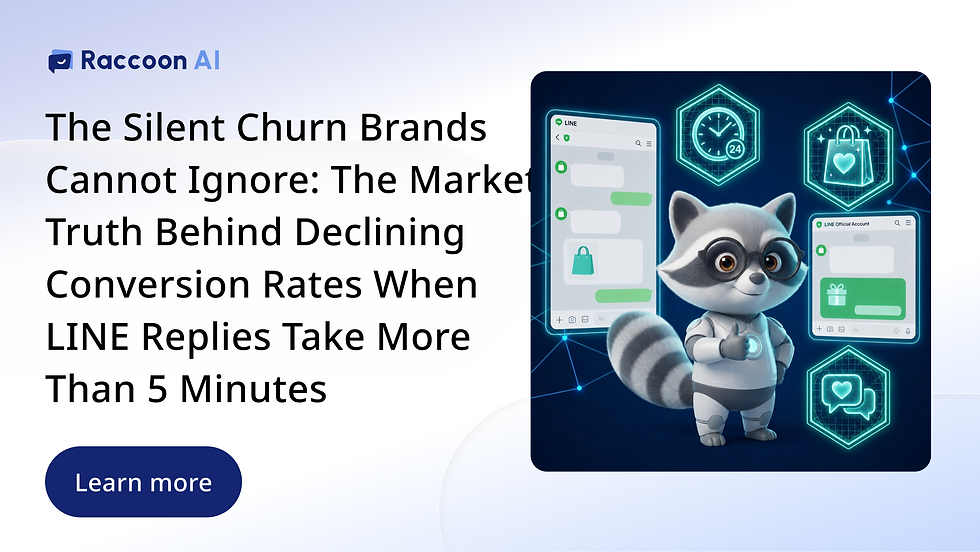
When consumers ask about products, inventory, pricing, or appointment details on LINE, what brands lose is often not just an “unread message.” It is silent churn that never gets recorded. Customer service understaffing and unfinished message queues may look like operational issues on the surface. But inside the sales funnel, they are early warning signs of declining conversion rates, weaker ad ROI, and a deteriorating customer experience.
Market Context: LINE Is No Longer Just a Messaging App. It Is an Entry Point for Consumer Decisions in Taiwan.
Any discussion about real-time customer service in Taiwan must include LINE. According to TWNIC’s 2025 Taiwan Internet Report, 88.13% of people in Taiwan use instant messaging apps, and LINE is the most frequently used instant messaging app among internet users, accounting for 90.26%. LINE Biz-Solutions, citing Nielsen’s 2025 LINE Usage Behavior Survey, also states that LINE has a 93% penetration rate in Taiwan. Users open LINE 14 times per day on average, while medium-to-heavy users open it 22 times per day on average.
This points to one clear reality: for most Taiwanese consumers, LINE is not a channel they check only when they have free time. It is a daily touchpoint where they expect immediate interaction. When customers ask questions on LINE, they are usually not just browsing. They are evaluating, comparing, confirming, and often already close to making a purchase.
What Is Silent Churn?
Silent churn happens when customers do not complain, leave a negative review, or explicitly cancel an order. They simply leave while waiting for a response. This type of churn is especially difficult for companies to detect because CRM systems rarely show a note that says, “The customer waited 7 minutes with no reply and bought from a competitor instead.”
In LINE conversations, silent churn often happens in three situations:
A customer asks about price, size, inventory, or plan differences but does not receive an immediate answer.
Ads generate a large volume of private messages, but customer service agents are handling too many conversations at once and cannot quickly identify who has the strongest purchase intent.
Message volume surges at night, on weekends, or during campaigns, while human agents are offline and the customer’s purchase intent cools down during the wait.
Why Are 5 Minutes So Important?
“5 minutes” is not a magic number. It is an operational threshold that helps teams examine whether their response speed is protecting or weakening conversion opportunities. A study by InsideSales analyzed 5,700,000 inbound leads and 55,000,000 sales interactions. It found that attempts made within the first 5 minutes converted 8 times better than attempts made between 5 minutes and 24 hours later. The same study also found that only 0.1% of inbound leads were actually contacted within 5 minutes.
This research was not designed specifically for LINE commerce scenarios, but it reveals the same behavioral logic: customer intent decays quickly. LINE is an even more immediate channel. Customers may be asking multiple brands at the same time and comparing different options. The brand that gives a clear answer first is often more likely to win the next conversation.
When Customer Service Teams Are Understaffed, the Problem Is Not Just Slow Replies
Many brands assume understaffed customer service only leads to message backlog. In reality, the issue has three layers.
First, opportunities cannot be prioritized. All messages sit in the same inbox, making it difficult for agents to identify high-intent customers in real time.
Second, repetitive questions consume human capacity. Questions about delivery, returns, sizing, business hours, and campaign rules appear repeatedly, leaving agents with less time to handle high-value sales conversations.
Third, reply quality becomes inconsistent. When people are overloaded, they are more likely to miss context, provide incorrect information, or rely on canned responses. To customers, this often feels almost the same as not being understood.
This is why LINE reply speed should not be treated as a customer service KPI alone. It is part of the brand’s revenue funnel. When paid ads drive people into LINE but conversations stall because the team is understaffed, the brand loses more than customer satisfaction. It also loses paid-acquisition opportunities that were already generated.
How Should Brands Optimize Their LINE Reply Workflow?
Brands should start by building a “5-minute reply SLA,” but the goal should not be superficial instant replies. Effective LINE reply optimization should include five key actions:
Set a first-reply SLA: High-intent messages, such as pricing, inventory, plans, appointments, and quotation requests, should receive a meaningful response within 5 minutes.
Build issue routing: Repetitive questions should be handled by AI or automation, while human agents focus on complaints, negotiation, complex scenarios, and high-intent opportunities.
Identify customer intent automatically: Do not rely only on message order. The system should detect whether the message is about purchase intent, after-sales service, complaints, general inquiries, or partnership needs.
Define human handoff rules: AI can answer first, but high-risk complaints, high-ticket inquiries, and special requests should be routed to human agents immediately.
Track funnel metrics: In addition to average response time, teams should monitor unreplied messages, the percentage of conversations exceeding 5 minutes, AI resolution rate, human handoff rate, conversion rate, and complaint risk.
How Can Raccoon AI Help?
Raccoon AI is not designed merely to “auto-reply” to LINE messages. Its value is helping brands turn large volumes of conversations into a manageable, prioritized, and trackable opportunity workflow.
Shinfei Study Abroad is one real-world example of using Raccoon AI across its official website and LINE Official Account. Many users who contact the brand through LINE come with clear needs. AI can first collect key information, identify the user’s direction, and then route the conversation to the appropriate business unit consultant.
This allows brands to stop relying solely on the speed of the agents currently on shift. Instead, AI can respond first, clarify first, tag and route first, and then pass the most important conversations to human agents.
Conclusion: The Real Competition Is Not Who Has the Most Agents, but Who Can Capture Intent the Fastest
Slow LINE replies may look like a staffing problem on the surface. At the core, however, the brand is failing to capture conversations at the moment when customer intent is highest. When a customer actively sends a message, they have already crossed the attention threshold and are looking for an answer that is fast, clear, and credible.
If brands continue to process every message through a traditional human queue, they will easily lose opportunities in places they cannot see. Implementing an intelligent customer service tool like Raccoon AI is not about replacing human agents. It is about freeing humans from repetitive questions so they can spend their time on the customers who most deserve attention.
FAQ
Q1: If a LINE reply takes more than 5 minutes, does that always mean the brand will lose the order?
Not always. However, replies that take more than 5 minutes increase the risk that customer intent will cool down or shift toward another brand. The 5-minute mark should be treated as an SLA threshold for high-intent messages, not an absolute rule.
Q2: When customer service teams are understaffed, should brands hire more people first or introduce AI first?
If the main issue comes from too many repetitive questions, heavy peak-time volume, or no coverage at night and on weekends, brands should usually introduce AI routing and knowledge-base replies first, then evaluate whether additional headcount is still necessary. This helps release human agent capacity first.
Q3: Will AI replies make customers feel like the brand is cold or impersonal?
The key issue is not whether the reply comes from AI. It is whether the response understands the question, answers the point, and can route the conversation to a human when needed. Good AI customer service should resolve simple questions first and hand complex or emotionally sensitive cases to people.
Q4: Which LINE messages should be prioritized first?
Messages about pricing, inventory, sizing, plan comparisons, appointments, quotations, campaign offers, partnership inquiries, and complaint risks should be prioritized. These messages usually indicate higher purchase intent or higher brand risk.
Q5: What types of brands are a good fit for Raccoon AI?
Raccoon AI is suitable for brands that receive large volumes of LINE, Facebook, Instagram, or website customer service messages every day, especially e-commerce, retail, education, healthcare, B2B services, and campaign-driven marketing teams. If your team often feels that there are too many messages and not enough people to reply, it is time to evaluate AI routing.
References
LINE Biz-Solutions, LINE BIZ CONVERGE 2025: https://tw.linebiz.com/news/LINE-BIZ-CONVERGE-2025/
TWNIC, 2025 Taiwan Internet Report: https://report.twnic.tw/2025/assets/download/TWNIC_TaiwanInternetReport_2025_EN_summary.pdf
InsideSales, Response Time Matters: https://www.insidesales.com/response-time-matters/
Salesforce, 2025 State of Service Report: https://www.salesforce.com/news/stories/state-of-service-report-announcement-2025/



Comments